Why Viewers Watch to the End: The Psychology of Retention
YouTube measures how many viewers stay past the first 30 seconds. What research says about curiosity and attention, and which cuts keep viewers watching.
Phil Duong
Builds Vidtrimmer
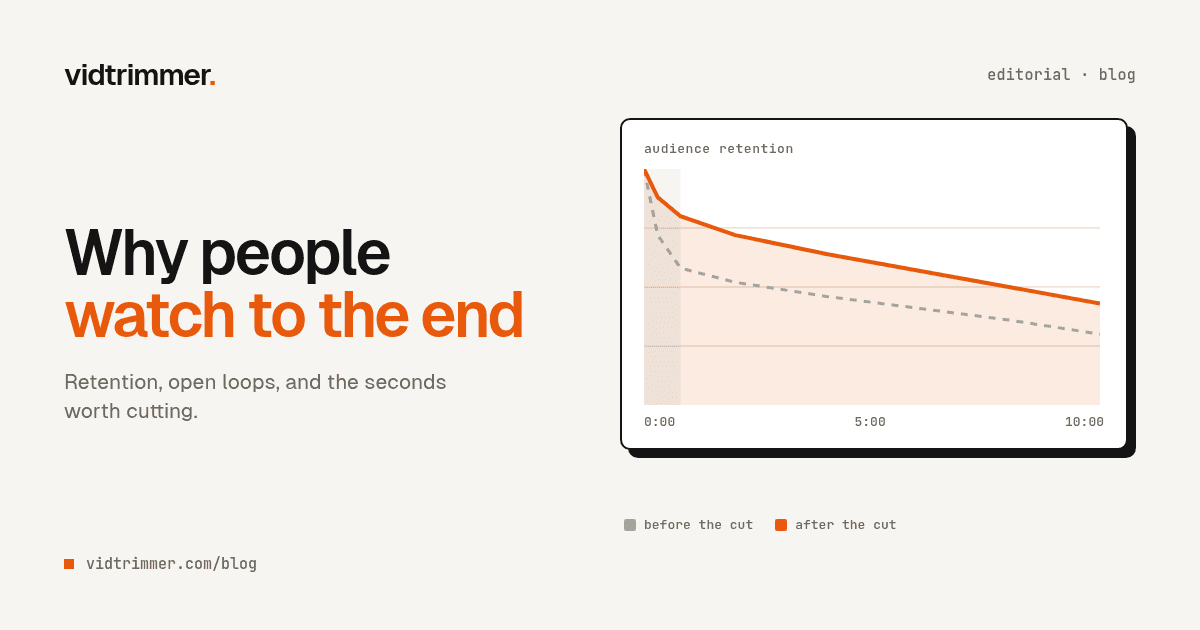
People do not stay to the end of a video because of luck or a magic hook. They stay because each section gives them a reason to watch the next one. YouTube even measures this: its retention report shows what percentage of your audience is still watching after the first 30 seconds (YouTube Help).
Key takeaways
- YouTube's retention report marks the intro, top moments, spikes, and dips, so you can see exactly where people leave (YouTube Help).
- The "8-second attention span" is a myth. People leave slow videos, not all videos.
- An open question keeps people watching only if the video answers it.
- The fastest fix for a weak curve is often a cut: a shorter intro, less dead air, and the best moment earlier.
What YouTube's retention report measures
The report breaks a video into four kinds of moments. Intro "tells you what percentage of your audience still watched your video after the first 30 seconds." Top moments are where "almost no one dropped off." Spikes are moments that were "rewatched or shared." Dips are moments that were "either skipped" or where viewers stopped watching completely (YouTube Help).
This matters beyond your own analytics. YouTube says recommendations "drive a significant amount of the overall viewership" and that it measures "valued watchtime", the time spent on videos that viewers rate as valuable in surveys (YouTube Blog, 2021). A video that keeps people satisfied is more likely to be recommended.
YouTube's own advice for a weak intro is direct: "Modify the first 30 seconds of your video and experiment with different styles." It also checks whether the first 30 seconds "matched the viewer's expectation of the video's thumbnail and title." If the title promises a result and the first minute is a channel update, the curve shows it.
Why do open questions keep people watching?
Because an unanswered question feels unfinished. In 1927, Bluma Zeigarnik reported that "memory is better for interrupted than for completed tasks" (MacLeod, Memory & Cognition, 2020). The effect is famous, but later replications are mixed, so treat it as a tendency, not a law.
The stronger account comes from behavioral economist George Loewenstein. His 1994 review describes curiosity as a feeling of deprivation that "arises from the perception of a gap in knowledge or understanding" (Loewenstein, Psychological Bulletin, 1994). Show people the gap, and they want it closed.
This may explain why "I tried X for 30 days" titles work. The viewer knows the question in the first second and the answer arrives at the end. Keep the loop honest:
- Open the question early. State the problem or the promise in the first 30 seconds, where YouTube measures the intro.
- Close it. If the payoff never comes, or it doesn't match the thumbnail, viewers feel tricked. Expect that to show up in likes, shares, and survey answers, which feed the same satisfaction signals.
Are attention spans really shrinking?
The evidence says no, and that matters for how you edit. The claim that people now have an 8-second attention span, shorter than a goldfish, came from a 2015 Microsoft report. The BBC traced the figure: it "did not actually come from Microsoft's research" but from a website called Statistic Brain, and neither of that site's listed sources could "find any record of research that backs up the stats" (BBC News, 2017).
Edward Vogel, a University of Chicago psychologist, told the Wall Street Journal that attention has been "remarkably stable across decades" (Wall Street Journal, 2017). People still watch three-hour podcasts and full films.
So the problem is rarely the viewer. People leave when a section stops paying off: a long intro, a point made twice, a pause while someone finds their notes. That is an editing problem, and editing problems have fixes.
Does video length change how much people watch?
Yes, the share of a video that people watch falls as videos get longer. Wistia's 2025 State of Video report, based on more than 100 million videos and webinars, found these averages, as reported by Chief Marketer (2025):
| Video length | Average share watched |
|---|---|
| Under 5 minutes | 47% |
| 5 to 30 minutes | 38% |
| Over 30 minutes | 21% |
These are business videos hosted on Wistia, not YouTube, so read them as a direction, not a benchmark.
Don't read the table as "make every video short". A 40-minute tutorial that people need will hold them. Read it as "every minute has to earn its place", because a long video loses more viewers to each slow minute.
Cut what makes viewers wait
Most drop-off fixes are cuts. YouTube's help page suggests that if your top moments come late, you should consider moving that content earlier. In practice, these cuts help most often:
- The intro before the promise. Logos, greetings, and "before we start" segments sit exactly in the 30 seconds YouTube measures. Start with the problem.
- Dead air. Pauses, restarts, and "so, yeah" moments are small, but they add up across a 15-minute video.
- Repeated points. If the dips line up with a recap, the viewer already got it.
- The setup for a payoff that comes too late. Move the strongest moment forward, or tease it in the first 30 seconds.
Then check the result in the retention report, not by feel. The dips tell you where the next cut belongs. If you re-export to make the cuts, the lossless cut guide shows how to keep the quality.
Can you reuse the moments people rewatch?
Yes. Spikes in the report are moments people "rewatched or shared", and they are strong candidates for short clips. Download the section as an MP4 with Vidtrimmer's clip downloader, crop it to vertical, and post it as a Short or a Reel that points back to the full video. The vertical video guide covers the cropping step.
Questions
What is a good audience retention rate on YouTube?
There is no single number, because retention depends on length and topic. Compare a video with your own channel's typical curve. YouTube's report shows how many viewers stay past the first 30 seconds, and marks the dips where people skip or leave.
Is the human attention span really 8 seconds?
No. The 8-second figure in a 2015 Microsoft report was cited from a website called Statistic Brain, and the BBC found no research behind it. A University of Chicago researcher told the Wall Street Journal that attention has been remarkably stable across decades.
How long should a video be to keep viewers?
Shorter videos hold a larger share of their viewers. Wistia's 2025 data shows an average of 47% watched for videos under five minutes, 38% for 5 to 30 minutes, and 21% over 30 minutes. Length should still follow the content, not a target.
What is the Zeigarnik effect?
It is the finding, first reported by Bluma Zeigarnik in 1927, that people remember interrupted tasks better than completed ones. Video creators use the same idea when they open a question early and answer it later, but later studies show mixed results.
Need a clip from YouTube? Paste the link, set a start and end time, and download the MP4.
Trim a YouTube videoMore Articles
Why Vertical Video Is Winning, and How to Clip a Short
YouTube Shorts average over 200 billion daily views, and 37% of US adults use TikTok. Why vertical won the phone, and how to cut a long video into a Short.
October 10, 2026
How to Trim a YouTube Video: 3 Ways That Work
Trim a YouTube video with Clips (5 to 60 seconds, shared as a link), the Studio editor for your own uploads, or download only the part you need as an MP4.
October 10, 2026